

Many companies are now starting to care about a new question: when other people ask AI search tools a relevant question, why is my company not mentioned?
On the surface this looks like an AI visibility problem, but it often does not start with AI at all. It starts with the website structure, the page content, and the way the business is expressed.
AI search does not understand a company out of thin air. It reads public pages, page titles, service descriptions, FAQs, structured data, company entity information, contextual relationships, and other accessible public content.
If your website itself has not explained the business clearly, AI tools will naturally find it hard to accurately understand who you are, what services you offer, which customers you suit, which market you serve, and which problems you relate to.
So many companies are not "not recommended by AI." They have simply not yet been correctly understood by AI.
When AI search cannot understand a business, it is usually not a technical problem
Many companies, on hearing the terms AI search, GEO, and Schema, assume this is a purely technical problem. It is not entirely so.
GEO, which can be understood as Generative Engine Optimization, focuses on this: when a user asks a question through an AI tool, is your website and public content clear enough for the AI to accurately understand, categorize, and cite your business?
Schema, that is, structured data, is a way of marking up content to help search engines understand a page. It can tell a search engine: this is company information, this is a service, this is an FAQ, this is an article, this is an address, this is contact information.
But the issue is that technical markup can only help machines read the content; it cannot create clear business expression for you. If a page itself is written vaguely, then no matter how complete the Schema is, it only marks up an unclear piece of information more neatly. The AI still does not know what problem you actually solve.
A disorganized website structure is the first cause of AI misunderstanding
For many companies, the problem with their website is not too little content but unclear structure.
The homepage tries to say everything: company history, products, services, vision, news, customers, and slogans, all piled together. The service page does not distinguish who the service is for, nor explain what is delivered. The case page reads more like a press release, with no visible customer scenario or actual result. The contact page leaves only a form, without explaining who it suits to contact or what materials should be sent.
For a human, such a website is already hard to follow. For AI search, misjudgment is even more likely.
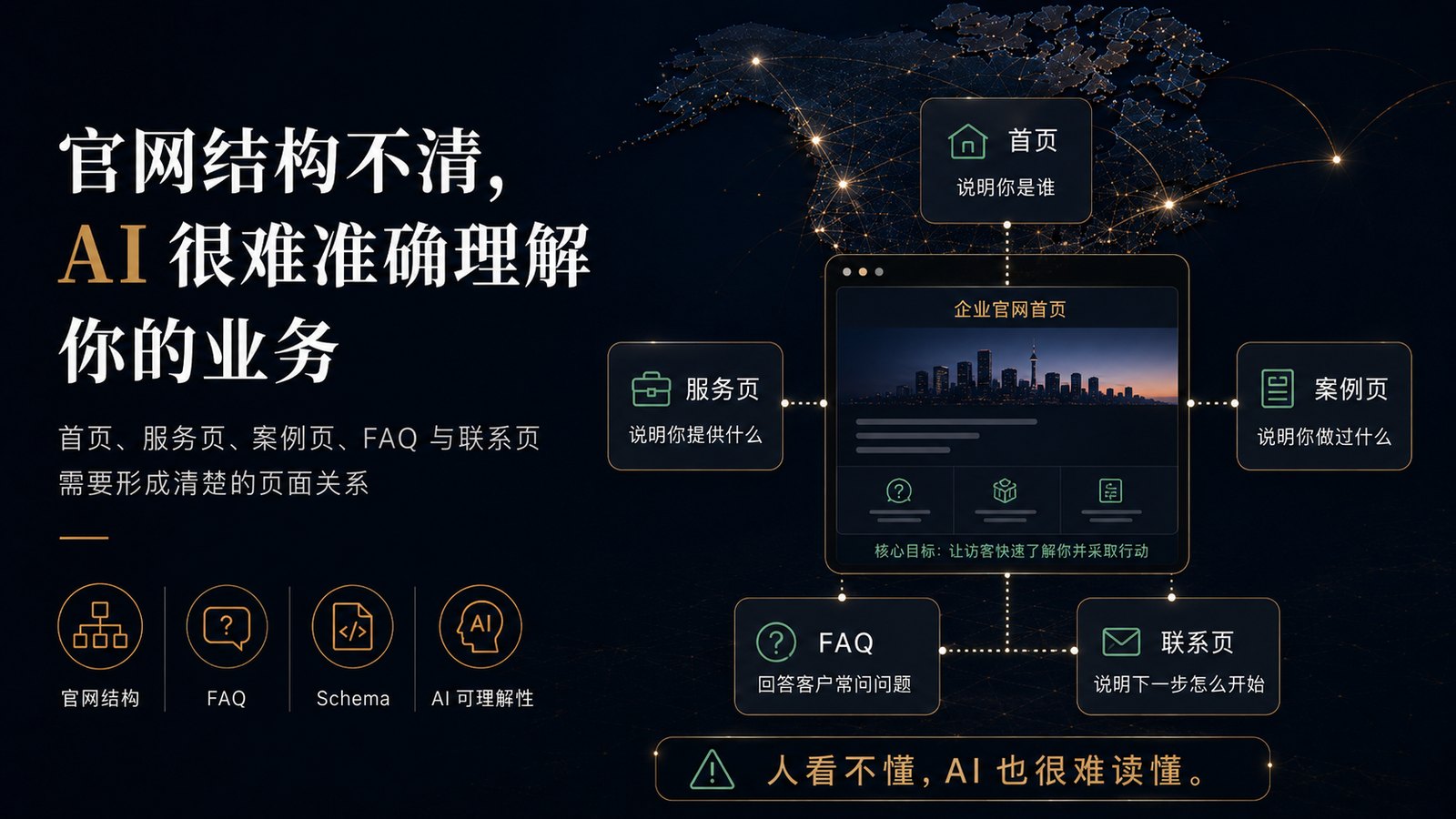
AI tools need to understand your business from the relationships between pages: the homepage explains who you are, the service page explains what you offer, the case page explains what you have done, the FAQ explains what customers commonly ask, the contact page explains how to begin the next step, and the About page explains the company entity and credible background.
If there is no clear relationship between these pages, the AI finds it hard to judge which page represents your core business and which is only supplementary information. A website suited for AI search understanding is not necessarily complex, but its structure must be clear.
An unclear scope of service leaves AI unsure of which questions you should appear in
Many companies like to write phrases such as "one-stop service," "professional solutions," "global customer support," and "high-quality delivery" on their websites. These phrases help AI search very little.
AI needs clearer information: who do you serve? What problem do you solve? Which specific services do you offer? What scenarios are those services suited for? In which countries or cities do you operate? Which keywords, industries, and customer needs do you relate to?
For example, a company that says it "helps businesses go global" is making too broad a statement. AI does not necessarily know whether you do logistics, compliance, marketing, website building, channels, trade shows, media content, or market entry consulting.
But if the page states clearly: helps Chinese companies enter the Canadian and North American markets; provides website credibility audits, bilingual business content, AI search readability, market entry readiness, and commercial connection readiness; suited for B2B companies preparing to connect with customers, channels, service providers, and partners, then AI finds it much easier to relate you to topics such as "entering North America," "North America market entry," "website credibility," "bilingual business communication," and "market entry materials."
The clearer the service boundaries, the easier it is for AI to understand which kinds of search scenarios you should appear in.
FAQs are not decoration; they are an important entry point for AI to understand a business
Many company websites have an FAQ, but it is written too much like an after-sales page, answering only shallow questions: how much does it cost? How long does it take? How do I get in touch? Are there discounts?
These questions can of course be included, but if the FAQ stays only at the transactional level, it wastes a very important opportunity.
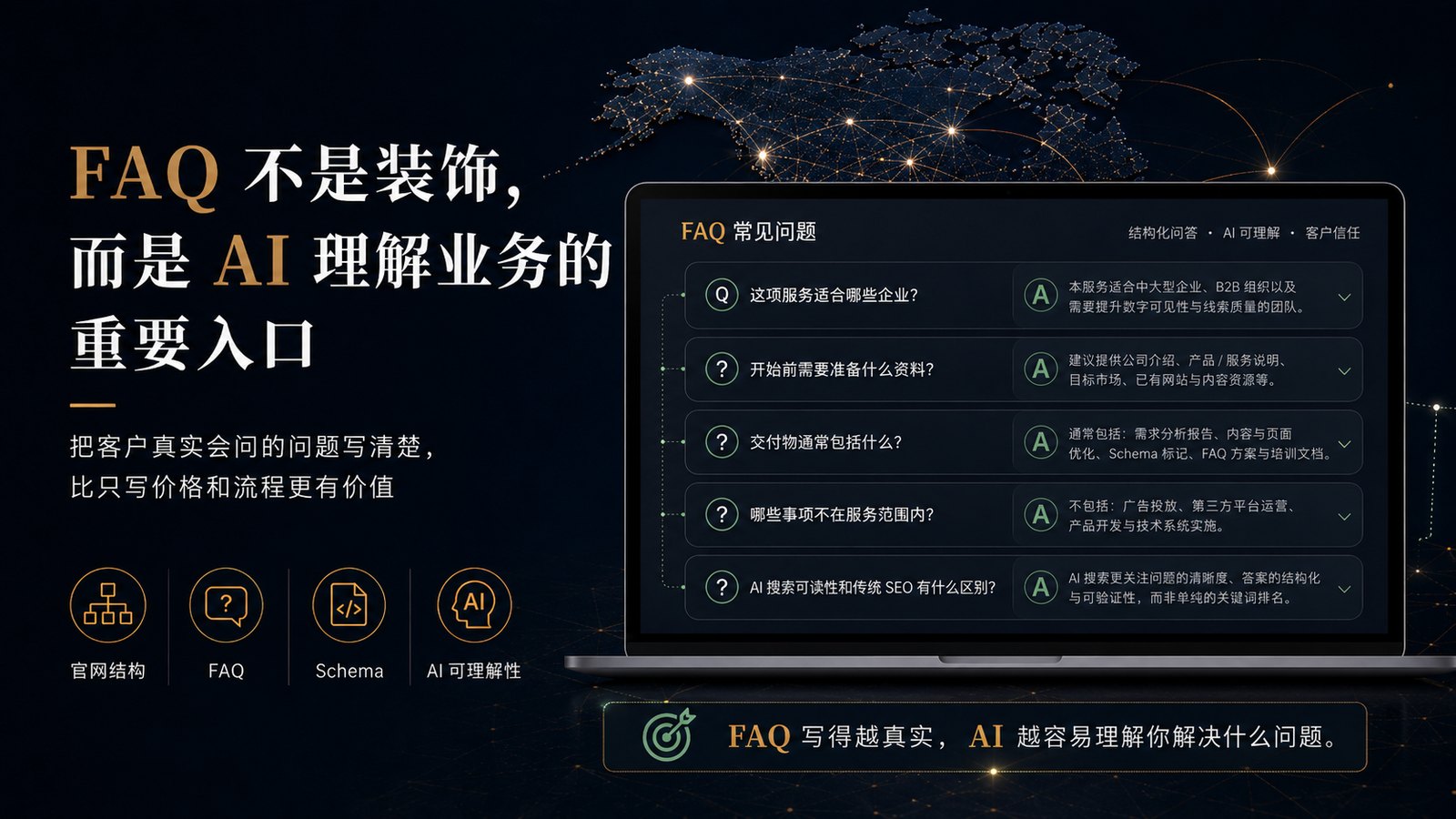
The FAQ is an entry point that helps people and AI understand the business at the same time. A good FAQ should answer the questions a real customer asks during the assessment stage: which companies is this service suited for? What materials should be prepared before starting? What are the deliverables? What is not included in the scope of service? If a company already has a website, what else needs to be done? Why can't Chinese and English materials be directly translated? What is the difference between AI search readability and traditional SEO? How does website credibility relate to market entry readiness?
These questions not only help customers judge but also help search engines and AI tools understand the page's topic. When the FAQ is written well, the website gains a layer of "question — answer — service" semantic structure. AI more easily recognizes which problems this company relates to and what type of needs it can solve.
Common Schema issue: structured data is added, but the content is still empty
Many companies assume that as long as the website has Schema added, search and AI will understand the business. This is also a misconception.
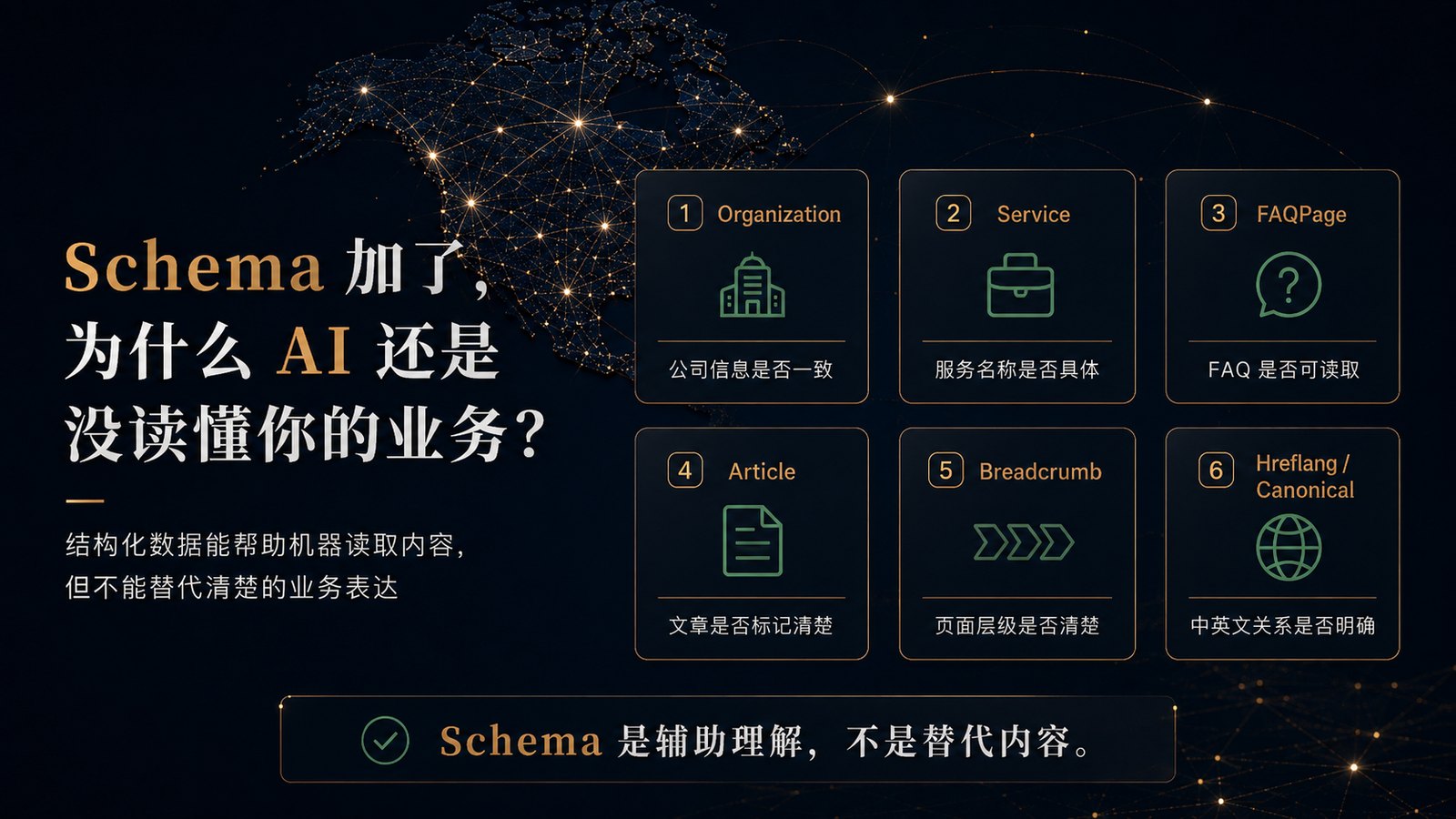
The role of Schema is to mark up content, not to replace it.
Common issues include: only Organization Schema is added, but the company introduction is unclear; the service page has no Service Schema, or the service name is too generic; the FAQ page has questions but no FAQPage Schema; the article page has no Article Schema; the breadcrumb structure is unclear and the page hierarchy is messy; the Chinese and English pages have no clear canonical and hreflang relationship; the company name, address, and contact details are written inconsistently across pages; and there are no internal links between the service page, case page, and FAQ.
These issues affect how a search engine understands the website entity, the page topic, and the content relationships. But the more fundamental issue is still whether the page itself has explained the business clearly.
If your service page only says "we provide professional service," then even with Service Schema added, it is hard for AI to know what you actually offer.
AI search readability is not about pleasing machines, but about explaining the business clearly first
When doing SEO, many companies think of keywords first. But in the era of AI search, keywords are only one part. What matters more are entities, semantics, context, and credibility.
Your website needs to be understood by machines and by real customers. These two things are not in conflict.
When a website explains its company identity, target customers, scope of service, proof of capability, FAQs, contact path, local responsibility, and page relationships clearly, it becomes easier for people to assess and easier for AI to understand.
Conversely, if people cannot follow it, AI struggles to understand it consistently. So AI search readability is not about adding a layer of technical packaging over existing messy content; it starts from business expression, turning the website into a clear, credible, and assessable information system.
Companies entering North America especially need to take AI understandability seriously
For companies preparing to enter the Canadian, U.S., or North American market, this issue matters even more.
Because North American customers, channels, service providers, media, and partners often will not learn about you only through the materials you proactively send. They may search for you, look at your website, read your English pages, and may also use AI tools to quickly learn about your company and services.
If your English pages read unnaturally, your scope of service is unclear, your FAQ is missing, your cases lack context, and your Schema is not configured, AI may well be unable to accurately identify your business.
This affects several stages: whether customers can quickly understand you; whether channels can judge the possibility of cooperation; whether service providers know how to coordinate; whether media or event organizers can distill your business story; and whether AI tools can connect you to the right questions.
Entering North America is not just about building an English website; it is about establishing a business information entry point that both the local market and AI tools can understand together.
Companies can first check these 6 questions
Before doing complex optimization, a company can first run a basic check.
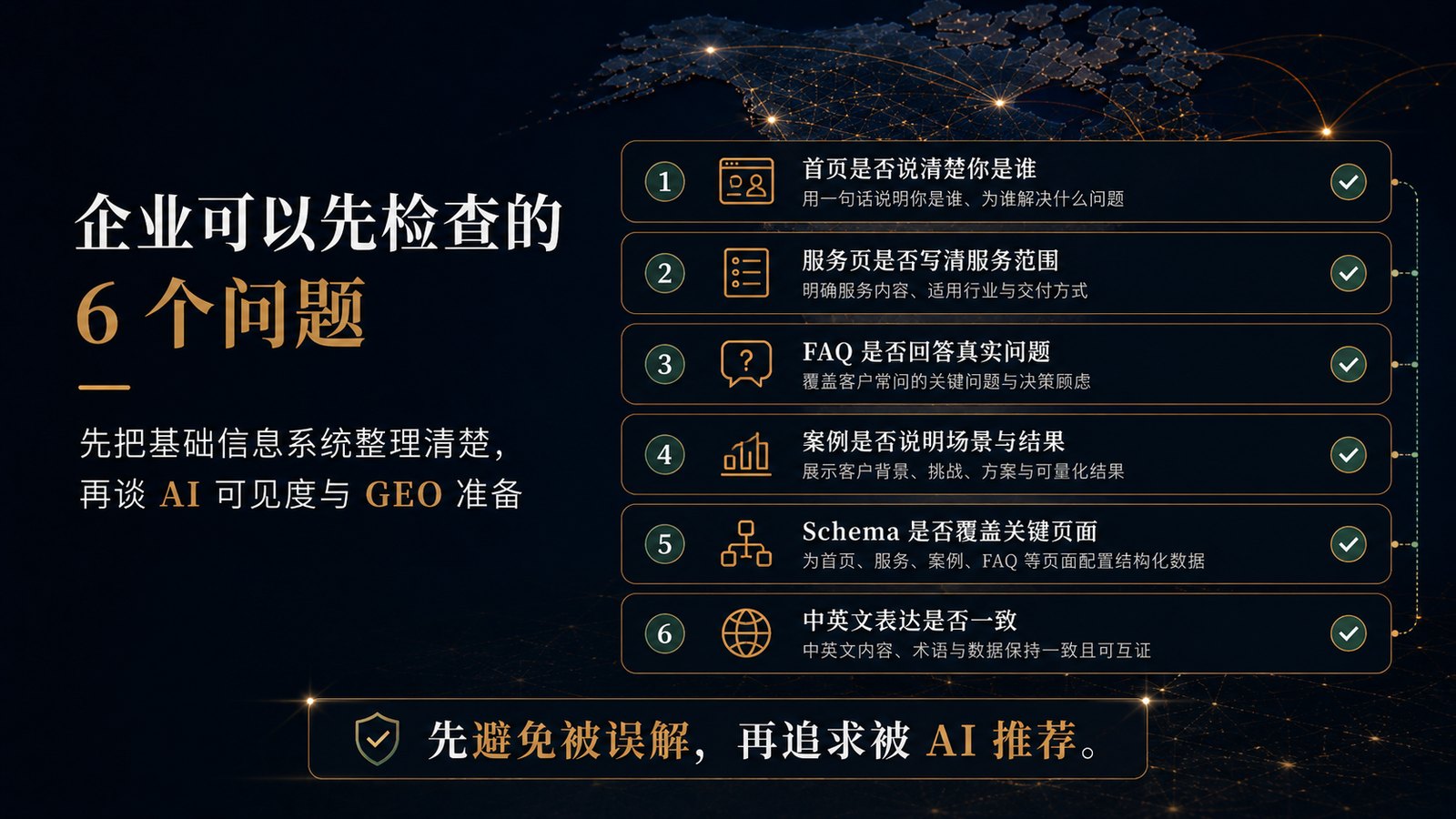
First, can the homepage explain who you are, who you serve, and what you offer within 10 seconds? Second, does the service page clearly state the scope of service, the target audience, and the deliverables? Third, does the FAQ answer the questions customers truly care about at the assessment stage? Fourth, do the cases explain the customer scenario, the problem, the solution, and the result? Fifth, does the Schema cover the company, services, articles, FAQs, and breadcrumbs? Sixth, are the Chinese and English pages consistent in expression and aligned with the reading habits of the target market?
If these 6 questions are not handled well, simply doing keywords, publishing articles, or adding technical markup will have limited effect.
Don't chase being recommended by AI first; first make sure you are not misunderstood
Of course companies want to be seen by AI search, indexed by search engines, and found by customers. But the first step is not to chase exposure; it is to avoid misunderstanding.
Is your business described correctly? Are your services clearly categorized? Are the relationships between pages clear? Does the FAQ cover real questions? Does Schema help machines read the content? Does the English expression fit the North American business context?
Once these basic questions are resolved, talking about AI visibility, GEO readiness, and content publishing becomes much more meaningful.
When AI search cannot understand your business, it is often not because you lack capability, but because the website has not turned that capability into information that can be read, assessed, and understood.
If your company is preparing to enter the Canadian, U.S., or North American market and already has a website, English materials, or service pages, you can first run an AI visibility and GEO readiness check. First judge whether the issue lies in the website structure, service expression, FAQs, Schema, or the consistency of Chinese and English content, then decide how to optimize next.
FAQ
What is the difference between AI search readability and traditional SEO?
Traditional SEO focuses more on keywords, page titles, backlinks, content quality, and search rankings. AI search readability focuses more on whether AI tools can accurately understand company identity, scope of service, applicable scenarios, FAQs, page relationships, and public information.
What does GEO mean?
GEO can be understood as Generative Engine Optimization. It focuses mainly on whether a website and its public content can be correctly understood, cited, and categorized by AI search, generative answers, and intelligent tools.
Will Schema definitely improve AI search visibility?
Schema can help search engines understand page structure, but it cannot replace clear content. If the business expression on a page is vague, adding Schema alone will not solve the core problem.
Why are FAQs important for AI search?
FAQs organize customers' real questions in a question-and-answer format, which helps search engines and AI tools understand what problems a page solves, and helps customers judge more quickly whether it is worth continuing the conversation.
Which Schema types does a business website need?
Common basic types include Organization, LocalBusiness, Service, Article, FAQPage, BreadcrumbList, and WebSite. Whether a specific type is needed should be decided based on the website structure and page content.
Why should businesses entering North America run an AI visibility check?
Because North American customers, channels, service providers, and partners may learn about a company first through search engines or AI tools. If the website structure, English content, scope of service, and FAQs are unclear, the business may not be accurately understood.
Want to know whether AI can accurately understand your business?
You can send your website link, English pages, service pages, or FAQ. We will first look at whether the issue is closer to website structure, service expression, FAQs, Schema, or the consistency of Chinese and English content.
Send Your Website or Materials View AI visibility and GEO readiness