
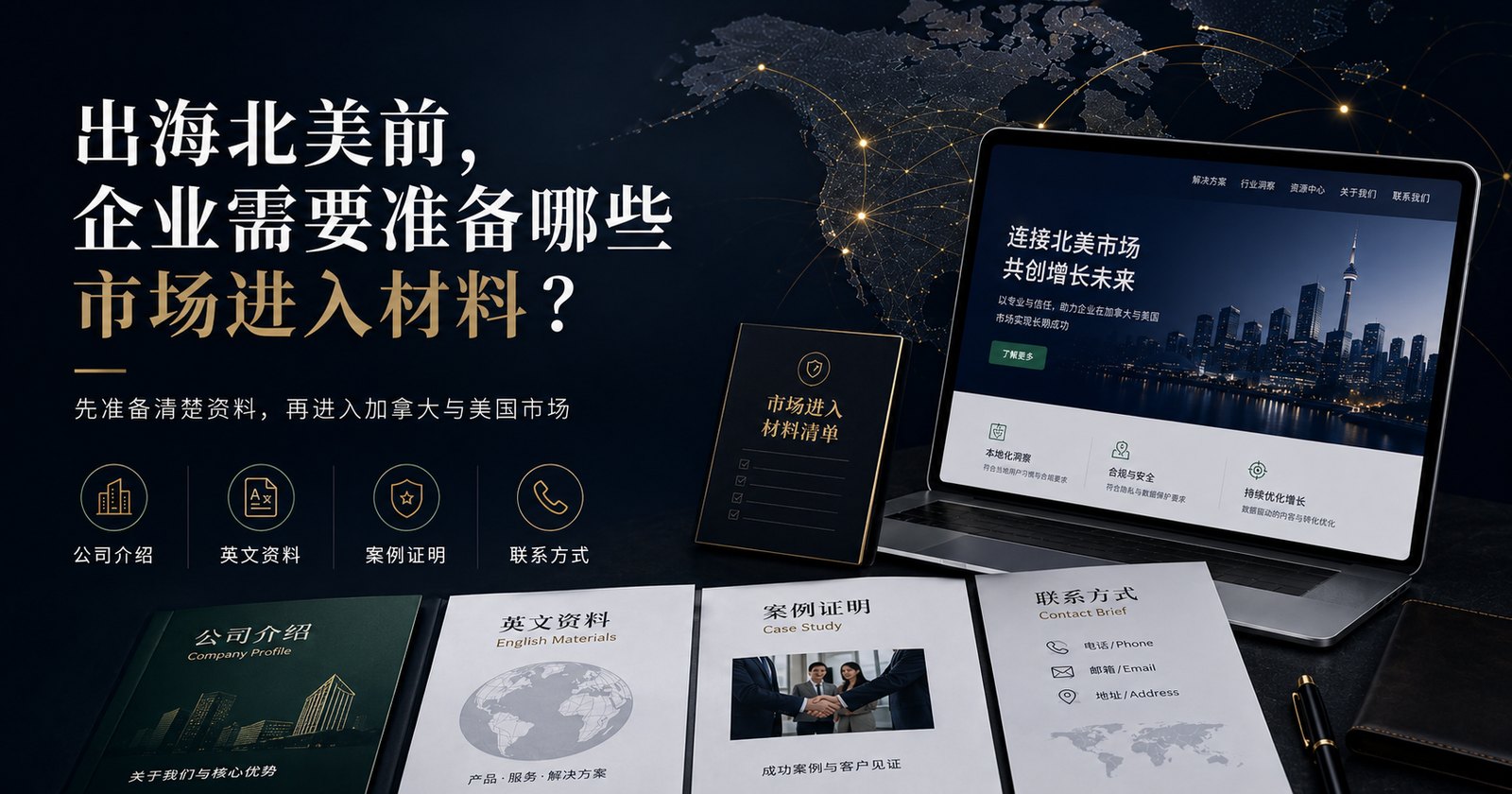
When companies talk about entering North America, the first instinct is often to find customers, find channels, find agents, and attend trade shows.
Those actions matter, but before actually reaching out to customers, channels, service providers, or potential partners, there is a more basic question that is often overlooked: are the materials you plan to show clear enough for the other side to assess you?
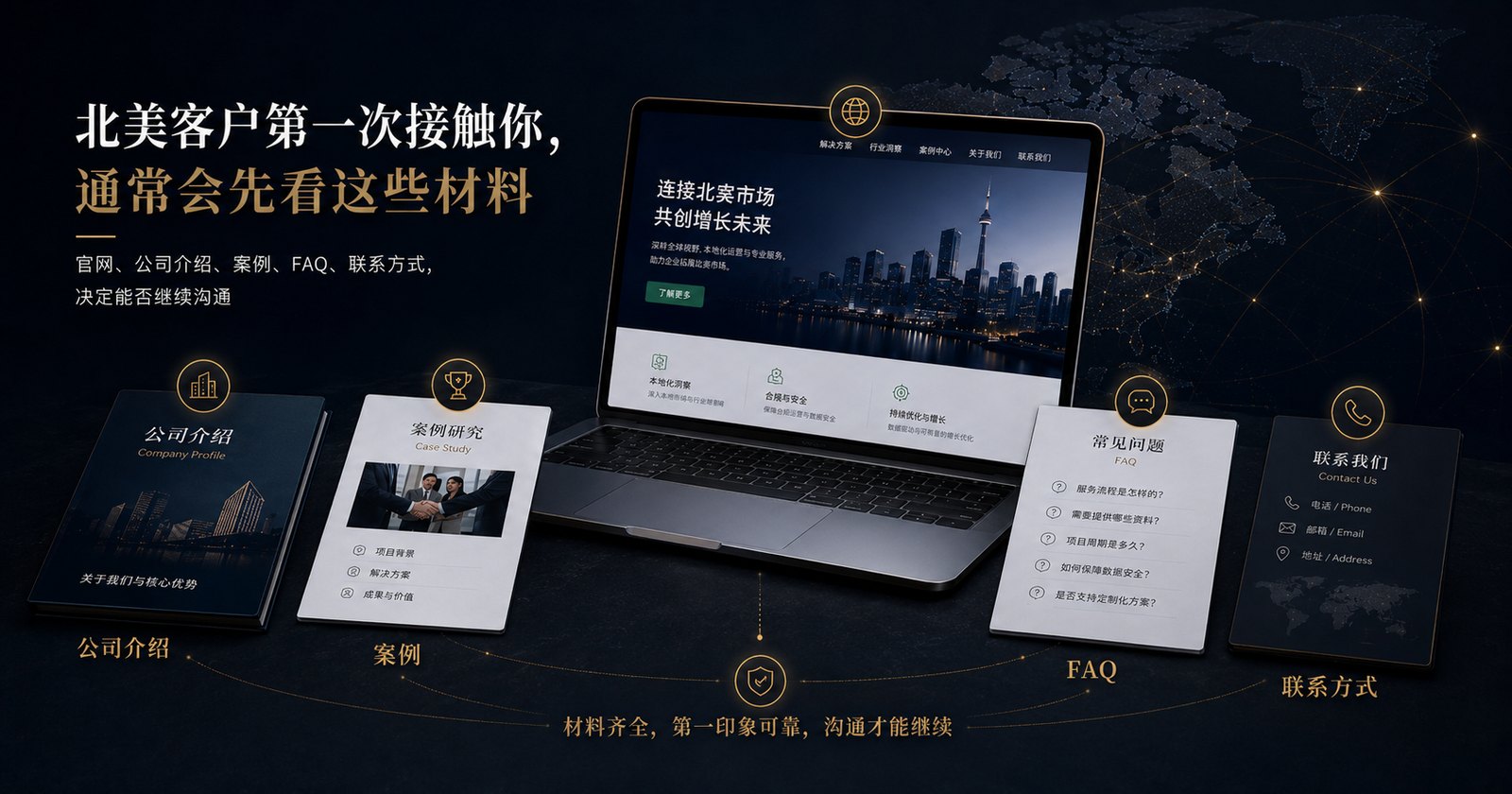
When a North American customer encounters a company for the first time, they usually do not jump straight into deep conversation. They first look at the website, company profile, English materials, product pages, cases, and contact details, and they may even use a search engine or AI tool to learn about the company beforehand.
If these materials do not explain things clearly, the other side will not necessarily point out the problem. They are more likely to simply not reply, or to move you onto a "look at later" list.
So before entering North America, market entry materials are not a formality. They are a precondition for whether business communication can even begin.
Market entry materials are not promotional materials
Many companies understand "market entry materials" as brochures, product catalogs, slide decks, or website pages. But for North American customers, what matters is not how polished the materials look, but whether they help quickly answer a few questions.
Who is this company? What exactly does it offer? Which customers is it suited for? Is there real proof of capability? When entering the Canadian or U.S. market, who is responsible for local communication, delivery, after-sales, and compliance-related matters? Who should be contacted next, what should be sent, and how does it move forward?
If these questions are not answered clearly, even the most beautiful brochure is just display material and cannot truly support market entry. Materials that genuinely add value make it easier for customers, channels, service providers, and partners to understand you, assess you, and keep in touch.
The first type of material: the company profile
Before entering North America, a business first needs a clear company profile.
The company profile here is not a long corporate history, nor an English translation of the website's "About Us" page. It should let North American readers quickly understand your identity: are you a manufacturer, a brand, a trading company, a platform, or a service provider? Where is your headquarters? Which markets do you mainly serve now? What are your core capabilities? Why are you preparing to enter the Canadian, U.S., or wider North American market?
Many Chinese companies' profiles tend to read like internal promotional copy, emphasizing scale, vision, awards, and slogans. But North American business readers care more about: what does this have to do with me? Are you a fit for my needs? Do you have a real business foundation?
A good company profile should briefly explain the company's positioning, core products or services, customer types, market experience, team capability, and cooperation direction. Its purpose is not to "make the company look big," but to let the other side quickly judge whether you are worth getting to know further.
The second type of material: English materials
Having English materials does not mean the materials are already suited to the North American market.
For many companies, the biggest problem with their English materials is not grammar but that the expression logic is still rooted in a Chinese business context. Phrases common in Chinese materials, such as "leading enterprise," "one-stop solution," "global presence," and "deeply rooted in the industry for years," easily look vague in English without concrete supporting detail.
What North American customers need is more direct information: what product or service do you provide? Which application scenarios is it suited for? How can the other side purchase, cooperate, or communicate further? Are product specifications, scope of service, delivery methods, and after-sales arrangements clear?
For a B2B company, English materials should at least include a company introduction, product or service descriptions, core page copy, case summaries, an FAQ, and a short, forwardable introduction. English materials are not about looking international; they are about reducing the cost of understanding for the other side.
The third type of material: product or service descriptions
Many companies have a product catalog but no product or service descriptions truly suited for North American customers to read.
A product catalog usually answers the "what do you have" question, but market entry materials also need to answer "who is it for, how is it used, how is it delivered, and where are the boundaries."
For a product-based business, you need to explain the product category, application scenarios, key specifications, target customers, certification status, labeling and documentation readiness, and after-sales and warranty arrangements.
For a service-based business, you need to explain who the service is for, what it includes, the deliverables, the cooperation process, what materials the customer needs to provide, and which matters fall outside the scope of service.
The North American market places great importance on a sense of boundaries. The vaguer the scope of service, the harder it is for the other side to judge cooperation risk. So product or service descriptions are not only sales material; they are also responsibility-boundary material.
The fourth type of material: cases and proof of capability
Many companies say they have experience, customers, and capability, but the materials show no evidence of it.
North American customers usually do not build trust simply because a company calls itself "professional." They are more willing to see concrete proof. That proof can be customer cases, project backgrounds, industry application scenarios, trade-show records, partners, media coverage, certification documents, team experience, on-site photos, delivery records, or customer feedback.
A case does not have to be long, but it should answer three questions: who is the customer or what is the scenario? What problem did you solve? Where is the result or value reflected?
For companies just entering the North American market without local cases yet, you can first organize cases from the Chinese market, Asian-market cases, cross-border project experience, proof of production capacity, or product application scenarios. The point is not to exaggerate, but to let the other side know that you are not just a single product page but a business with a real foundation.
The fifth type of material: local responsibility notes
When entering North America, many companies tend to overweight the sales chain and underestimate the responsibility chain.
Customers, channels, and service providers will care about: who is the responsible importer? Does the product involve certification, labeling, safety documentation, or local regulatory requirements? If a quality problem arises, who handles after-sales? Who is responsible for returns, repairs, training, installation, and complaints? Are there already local partner resources in Canada or the U.S.?
These questions do not all have to be handled by the company itself, but they must be acknowledged in the materials. If a company makes no mention of local responsibility arrangements at all, the other side will feel that follow-on cooperation carries high risk.
For companies preparing to enter the Canadian or U.S. market, you can first prepare a responsibility-boundary checklist that states which parts are already ready and which parts need further confirmation from local partners, certification bodies, logistics and warehousing, or legal and customs professionals. Clearly stating the boundaries is more credible than vague promises.
The sixth type of material: contact details and the next-step path
For many companies, the problem with their materials is not that the content is too sparse, but that after reading it the reader does not know what to do next.
After a North American customer or partner finishes reading the website and materials, they need a clear contact path: who should they contact? Which email? Is there a local phone number? What materials should be sent in the first contact? After they submit information, what happens next? Is it appropriate to book a meeting, or to first send a company introduction and product materials?
If the contact method is just a form, or only a generic mailbox, the customer may hesitate. Especially in B2B cooperation, the other side wants to know what communication process they will enter after reaching out.
Contact details are not footer information; they are part of the commercial connection path.
Why prepare these materials before promotion and trade shows?
Many companies first go to trade shows, run ads, add customers, and find channels, and only then discover their materials are not enough.
A customer asks for a company profile, and there is no suitable English version. A channel asks about scope of service, and the page cannot explain it. A service provider asks about local responsibility, and the company has not organized it. Media or an association asks for a company introduction, and a version has to be hastily assembled. After the trade show there are contacts, but no forwardable, follow-up-ready, reusable materials.
This situation is very common. The problem is not that the company lacks opportunities, but that when opportunities arrive, the materials cannot catch them.
So market entry materials are best prepared before formal promotion, exhibitions, and channel development. At a minimum, they should let a customer form a basic assessment the first time they encounter you.
Entering Canada and entering the U.S. also call for different material preparation
Many companies write the North American market simply as "North America," but Canada and the U.S. are not entirely the same market.
The U.S. market is larger with more opportunities, but its states, cities, channels, compliance, and competitive environment are also more complex. The Canadian market is smaller in scale, but for some companies it can serve as a more controllable starting point for validating North America, especially in cities such as Toronto and Vancouver that have substantial cross-market resources.
If a company plans to enter Canada first and then gradually expand into the U.S., the materials should make clear: why choose Canada as the starting point? Who are the target customers? Are there local service or cooperation resources? What is being validated in the Canada stage? How will it expand into the U.S. or the wider North American market in the future?
This kind of information lets the other side see that the company is not entering the market blindly, but is preparing for market entry step by step.
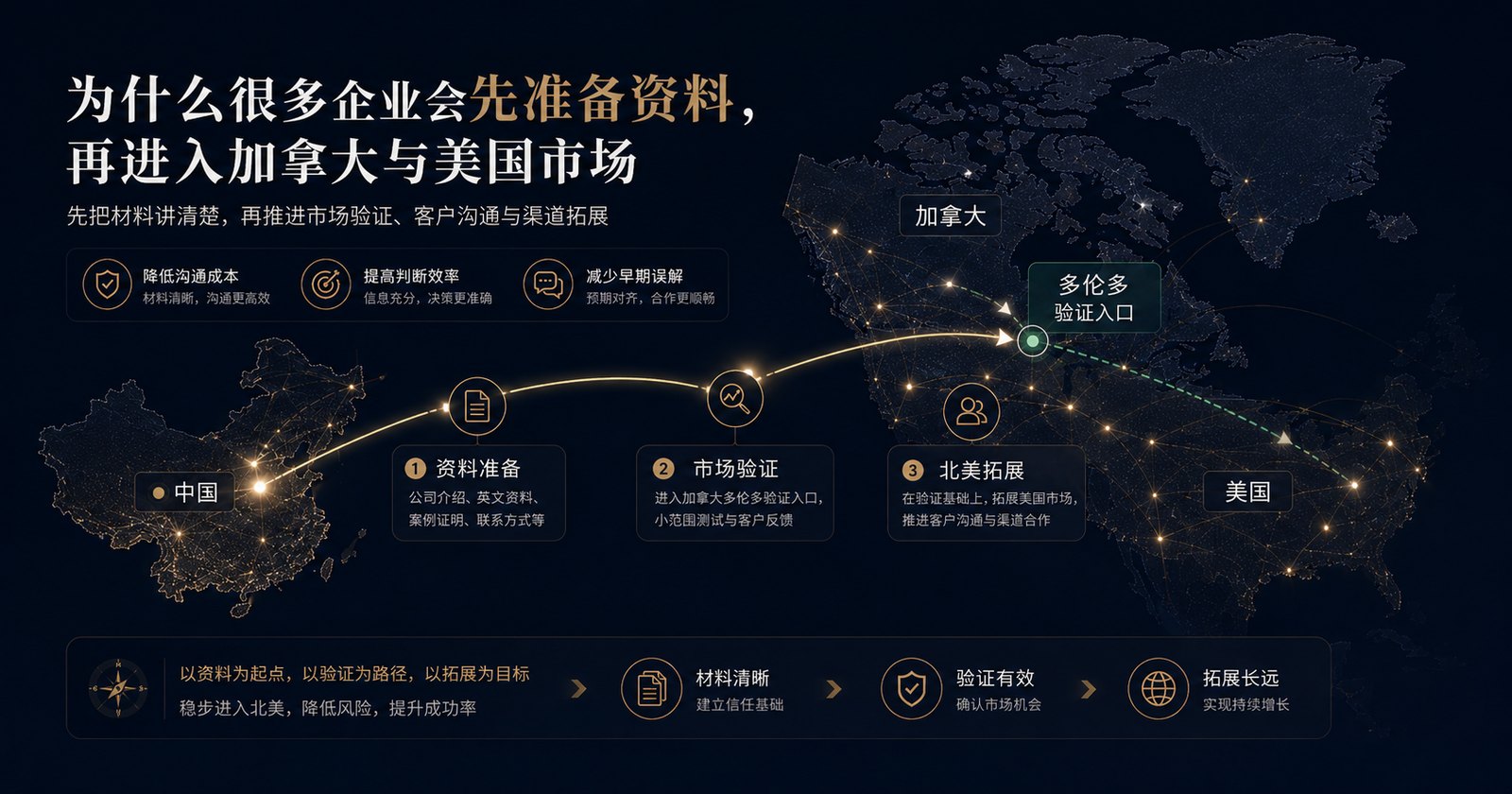
You do not need a complete plan at the start, but you do need assessable materials first
Many companies worry whether they need a complete market entry plan from the very beginning. Not necessarily.
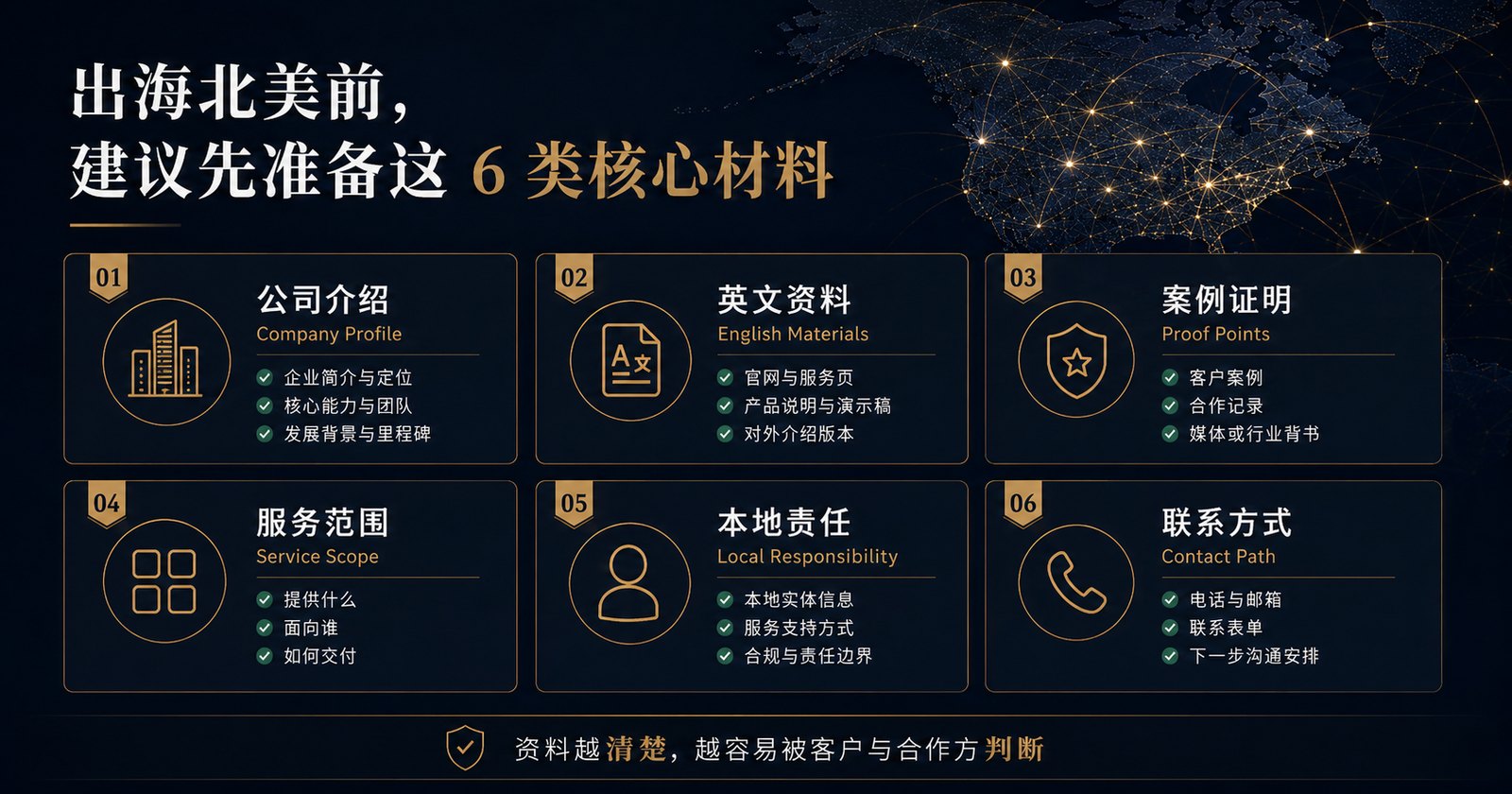
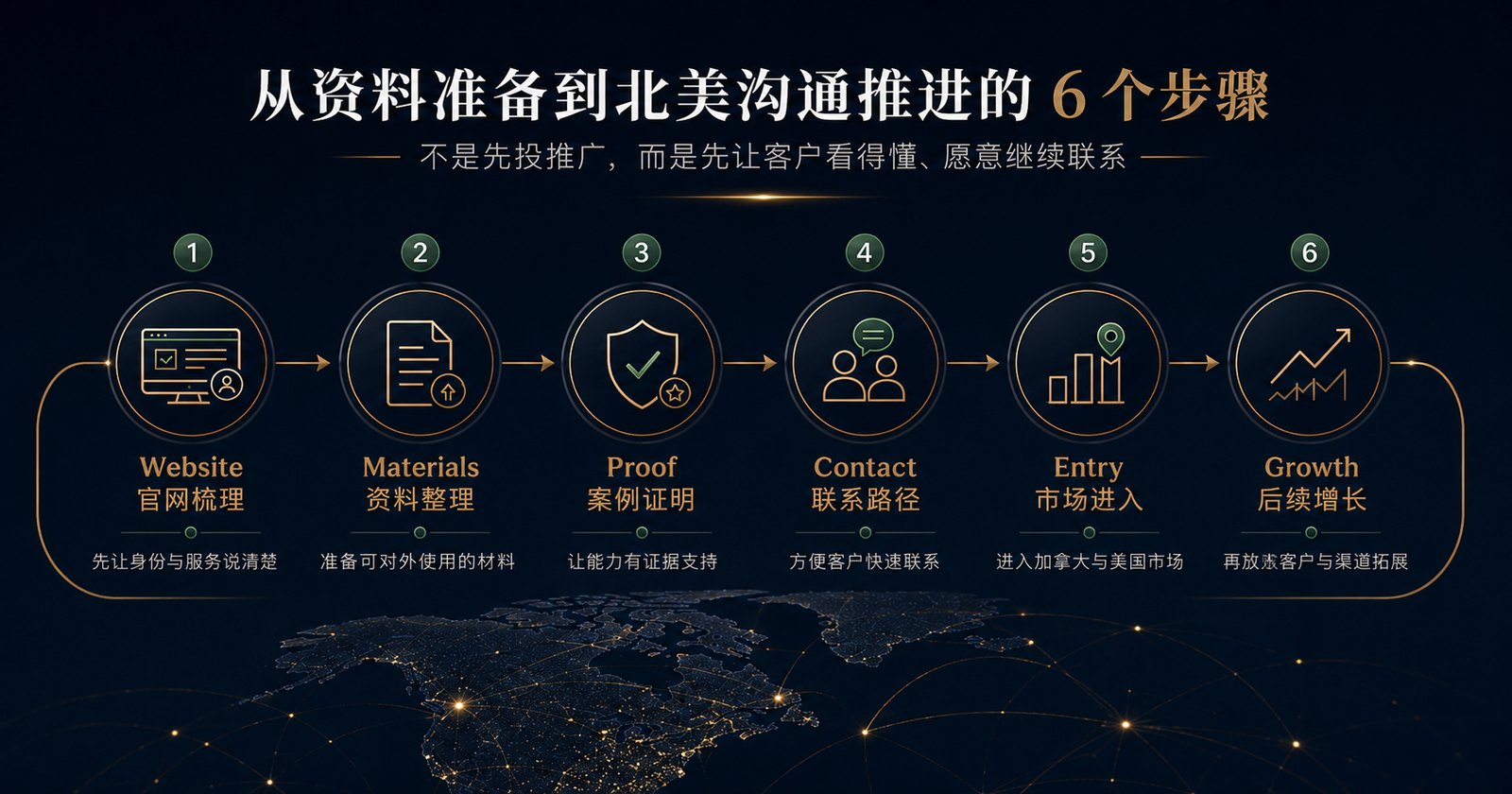
A more realistic starting point is to first prepare the most basic materials that most affect communication: a company profile, an English company introduction, a clear product or service page, a set of cases or proof of capability, a local responsibility checklist, and a clear contact method and next-step path.
These materials do not have to be thick, nor perfectly complete from the start. But they must allow customers, channels, service providers, and partners to assess you.
If, after reading the materials, the other side still does not know who you are, what you do, who you are suited for, what proof you have, or how to reach you, then the sales actions that follow will be very hard going.
Entering North America: first make the business understandable, assessable, and contactable
Entering North America is not simply selling products into Canada or the U.S.
It is first of all a process of rebuilding business trust. In that process, market entry materials carry the basic explanatory work: letting an unfamiliar market know who you are, letting potential customers judge whether you are relevant, letting service providers know how to coordinate, letting channels see the possibility of cooperation, and giving follow-on communication a basis to continue.
Many companies are not short of opportunities; they are short of a set of materials that can catch those opportunities.
Preparing the materials clearly first, and then doing promotion, exhibitions, customer development, and channel outreach, raises the success rate and lowers the cost of communication.
If your company is preparing to enter the Canadian, U.S., or North American market, you can start from the materials you already have. Send your website link, company introduction, English pages, product materials, or current communication problems, and we can first assess where the issues most affect customer understanding and contact, then decide how to add materials, revise pages, or advance market entry preparation next.
If you are preparing your North America market entry materials
You can start by sending your website link, company introduction, English pages, product materials, service pages, or current communication problems. We will first assess whether the issue is closer to website credibility, bilingual business content, market entry readiness, or commercial connection readiness.
View market entry readiness · View bilingual business content · View website credibility audit · Send materials
Frequently asked questions
What materials should a business prepare first before entering North America?
Start with a company profile, English materials, product or service descriptions, proof of capability, local responsibility notes, and a contact path. These materials help customers and partners quickly assess your identity, capability, and the next step for communication.
If we already have a website, do we still need a separate company profile?
Yes. The website is a public entry point, while a company profile is better suited for customers to forward, for channel conversations, trade-show follow-up, pre-meeting materials, and internal review by partners. They serve different purposes, but the content should stay consistent.
Can English materials just be a direct translation of the Chinese materials?
Direct translation is not recommended. English materials need to match the way North American business readers assess a company, focusing on identity, target customers, scope of service, proof of capability, and contact path, rather than copying Chinese marketing language.
What if the business has no North American cases yet?
You can first organize cases from the Chinese market or other overseas markets, product application scenarios, production capacity, certification readiness, trade-show records, or team experience. The key is to provide real, assessable proof of capability rather than vague claims.
How do market entry materials relate to website credibility?
Website credibility is part of your market entry materials. Customers usually look at the website, company profile, English materials, cases, and contact path together. If these are inconsistent or unclear, it affects whether the other side continues the conversation.
Which materials can CCBONLINE help prepare?
CCBONLINE can help businesses organize website credibility, bilingual business content, market entry materials, case presentation, FAQs, service boundaries, business introductions, and an initial contact path. Matters involving law, tax, certification, customs, or investment should be confirmed by the relevant licensed professionals.
This article reflects CCBONLINE's general business observations based on experience with cross-market business communication, website credibility, bilingual business content, and market entry readiness. It is not legal, financial, tax, investment, certification, customs, or other professional advice. For specific compliance, contract, tax, certification, or import-clearance matters, consult the relevant licensed professionals or qualified service institutions.